Evaluating the Star Mandala SVG Laser Cut Design for Precision Craft Projects
For laser-cutting enthusiasts and professional makers, selecting the right digital file is often the most critical step in the fabrication process. The Star Mandala SVG Laser Cut Design has emerged as a popular choice for those seeking a balance between geometric precision and organic elegance. Unlike standard vector files that may rely on simple shapes or repetitive patterns, this specific design category combines radial symmetry with intricate star motifs to create visually complex results. Understanding what distinguishes this design from other mandala styles, and knowing when it is the appropriate tool for your specific material and machine capabilities, is essential for achieving high-quality outcomes.
Defining the Characteristics of the Star Mandala Format
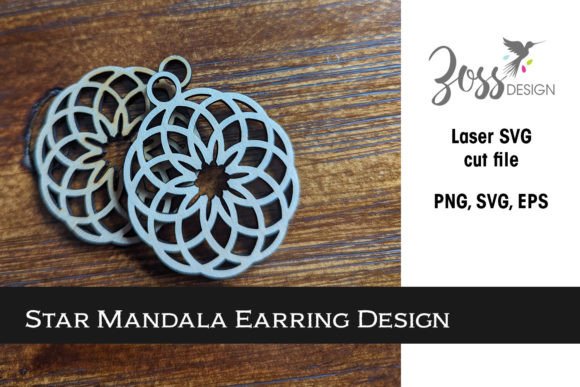
At its core, a Star Mandala SVG is defined by its radial symmetry and the interplay of sharp angular points typical of stars with the flowing continuity of circular mandala structures. The "SVG" (Scalable Vector Graphics) format ensures that the design remains crisp regardless of scaling, which is vital for laser cutting where path accuracy determines the final edge quality. What makes the Star Mandala SVG Laser Cut Design distinct is the density of its nodes. A well-constructed file in this category will optimize anchor points to prevent the laser head from stuttering while maintaining the delicate bridges necessary for structural integrity.
These designs typically feature multiple layers of geometric progression. The innermost rings often contain fine details suitable for small-scale projects like jewelry pendants or earrings, while the outer rings expand into bolder shapes ideal for wall art or large decorative panels. This versatility allows a single file to serve multiple purposes, provided the user understands how to scale the vector paths relative to their material thickness. The distinction lies not just in the visual aesthetic, but in the engineering of the cut paths themselves.
Comparative Analysis: Star Mandalas vs. Alternative Geometric Styles
When evaluating options for a new project, creators often weigh the Star Mandala against other geometric categories such as floral mandalas, pure tessellations, or abstract line art. Each style offers different tradeoffs regarding cut time, material waste, and structural durability.
- Floral Mandalas: These rely heavily on curved paths. While aesthetically soft, they can sometimes result in weaker joints in layered assemblies because curves offer less surface area for glue adhesion compared to the flat edges found in star points. A Star Mandala SVG often provides more robust connection points for 3D assembly.
- Pure Tessellations: Files focused on repeating grids are excellent for maximizing material usage on a sheet. However, they lack the focal point that a radial star design offers. If the goal is a centerpiece object rather than a background texture, the star mandala is generally the superior choice.
- Abstract Line Art: Single-line drawings are fast to cut but often lack the depth required for shadow-box effects. The multi-layered nature of a comprehensive Star Mandala SVG allows for depth creation through stacking, which abstract line files rarely support without significant modification.
The decision often comes down to the intended application. For functional items like coasters, the solid geometry of a star mandala provides better stability than open-work floral designs. Conversely, for hanging ornaments where weight is a concern, a less dense variation of the star pattern might be preferable to a heavily detailed alternative.
Material Compatibility and Technical Limitations
One of the most significant factors in choosing a Star Mandala SVG Laser Cut Design is matching the file's complexity to your available materials. Intricate designs with fine details demand materials that can hold thin bridges without breaking during the weeding or assembly process.
Wood and Plywood: Baltic birch plywood is the industry standard for these designs. The layered construction of plywood handles the intricate cuts of a star mandala well, provided the grain direction is considered. However, if the design includes extremely fine points (less than 1mm wide), lower-grade plywood with voids may splinter, ruining the aesthetic. In such cases, switching to acrylic or MDF might be necessary.
Acrylic and Polymers: For jewelry applications, acrylic offers a clean edge that highlights the geometric precision of the star points. The limitation here is heat management; intricate star tips can melt or fuse back together if the laser speed and power are not calibrated perfectly. A design that works beautifully in wood might require parameter adjustments when switched to polymer.
Paper and Cardstock: For prototyping or greeting cards, the star mandala format excels. The tradeoff is fragility. While the design looks stunning in paper, it lacks the structural rigidity needed for standing objects unless backed by a heavier substrate.
Decision Factors: When to Choose This Design Approach
Selecting the right file involves assessing your project goals against the capabilities of your equipment. The Star Mandala SVG is the optimal choice when you need a design that commands attention through symmetry and detail. It is particularly well-suited for:
- Layered Wall Art: The radial nature allows for easy stacking of different colored materials to create depth and shadow.
- Light Fixtures: The gaps between star points allow light to pass through, creating intricate projection patterns on walls.
- High-End Packaging: The elegance of the geometric star adds a premium feel to box lids or gift tags.
However, there are scenarios where this design may not be the best fit. If you are working with a low-power diode laser that struggles with fine detail, a simpler geometric pattern with thicker lines would yield cleaner results. Similarly, if production speed is the primary metric—such as in a high-volume manufacturing run—the extended cut time required for a highly intricate star mandala might make a simpler tessellation more cost-effective.
Optimizing the File for Production
Even the best Star Mandala SVG Laser Cut Design requires preparation before sending it to the cutter. Experienced users know that raw SVG files often contain overlapping lines or unjoined nodes that can cause the laser to trace the same path multiple times, leading to burn marks. Before cutting, it is advisable to import the file into your CAM software (such as LightBurn or RDWorks) to weld paths and remove duplicate lines.
Furthermore, consider the "kerf," or the width of material removed by the laser. In tight star points, kerf compensation is crucial. Without adjusting for the material loss, tight-fitting joints in a 3D assembled mandala may end up loose. Some advanced SVG files come with pre-compensated layers, but often the maker must apply this offset manually based on their specific machine and material combination.
Final Considerations for Project Success
The value of a Star Mandala SVG lies in its adaptability. It serves as a foundational element that can be scaled up for architectural installations or scaled down for delicate accessories. By understanding the interplay between the design's geometric complexity and your material constraints, you can avoid common pitfalls like breakage or excessive cut times.
Ultimately, the choice to use a Star Mandala SVG should be driven by the desired visual impact and the functional requirements of the final product. While it offers superior aesthetic potential for decorative pieces, it demands a higher level of precision in both file preparation and machine calibration compared to simpler alternatives. For makers willing to invest the time in tuning their parameters, the resulting blend of mathematical order and artistic flair makes this design category a standout resource in any digital library.